Agentic AI Course & Certification Training | Master AI Agents & Get Certified
Our Agentic AI Course in India helps professionals build practical expertise in designing, deploying, and managing intelligent AI agents that can reason, plan, and act independently in real-world business environments. Focused on hands-on implementation, autonomous decision-making, agentic workflows, and responsible AI adoption, this Agentic AI Certification in India equips learners with job-ready AI capabilities aligned with the fast-growing AI transformation demands across industries.
- GSDC-Accredited Agentic AI Certification
- Expert-Led Live Online Training
- Hands-On Learning with Real AI Agent Frameworks
- 5000+ Professionals Enrolled
- 4.8/5 Learner Satisfaction Rating
- Updated 2026 Curriculum with Industry-Relevant Use Cases

Agentic AI Course Certification and Training Overview
Agentic AI refers to intelligent AI systems and autonomous agents that can reason, plan, make decisions, and take actions independently to achieve specific goals with minimal human intervention. Indian companies, from IT firms in Bangalore to BFSI enterprises in Mumbai, are rapidly adopting AI-driven systems to automate operations, improve decision-making, and increase productivity. The professionals leading these initiatives are people who understand how intelligent AI agents think, plan, and act independently. This Agentic AI Course in India helps you build those practical, job-ready skills.
Whether you are an engineer building AI-powered workflows or a business leader driving digital transformation initiatives, this Agentic AI Training in India gives you the practical foundation to confidently work with next-generation AI systems.
Agentic AI Certification in India is accredited by GSDC, a globally recognized certification body whose credentials are valued by enterprises and hiring managers across India, the USA, UK, UAE, Canada, and other global markets. The program helps learners build practical expertise in autonomous agents, agentic RAG systems, AI workflow orchestration, and responsible AI adoption using modern frameworks and real-world business scenarios.
Curated for professionals worldwide, this Agentic AI Course in India is delivered fully online through flexible, live instructor-led sessions and recorded learning support. Whether you are based in Mumbai, Pune, Bangalore, Hyderabad, Chennai, Delhi, Kolkata, Ahmedabad, Jaipur, Chandigarh, or Kochi, you can access expert-led AI learning from anywhere.
Updated for the 2026 AI job market, the course includes hands-on exposure to LangChain, LangGraph, AutoGen, vector databases, and agentic RAG systems used across IT, BFSI, healthcare, consulting, and enterprise operations. With 5000+ learners trained and a 4.8/5 learner satisfaction rating, NovelVista helps professionals build practical AI implementation capabilities with confidence.

What You Will Get?

Learning Outcome of Agentic AI Course
After the completion of the course, the participants would be able to:
Training Calendar
English
- Self paced videos, assessments, recall quizzes, more
- For more details, reach us at training@novelvista.com
Includes Training, Exam & Certification
Lifetime Access
- Self paced videos, assessments, recall quizzes, more
- For more details, reach us at training@novelvista.com
Includes Training, Exam & Certification
Course Curriculum: Agentic AI Course
This Agentic AI course takes learners from foundational understanding to confidently designing, building, deploying, and managing intelligent AI agents step by step. Across 10 practical modules, this Agentic AI Training in India covers everything from core concepts and agent architecture to workflow orchestration, agentic RAG systems, ethical AI governance, and hands-on implementation using real-world frameworks and tools. Explore each module below and see exactly what your Agentic AI certification journey looks like.
Module 1. Introduction to Agentic AI+
This module of Agentic AI Training establishes a strong conceptual foundation by introducing the core ideas behind agentic systems and autonomous intelligence.
Defining Agentic AI and AI Agents: Characteristics and Autonomy
Learn what Agentic AI is and how AI agents differ from traditional systems by their ability to operate independently and adapt to changing environments.
Understanding Goal-Oriented Behavior
Explore how AI agents define goals, evaluate options, and choose actions to achieve outcomes without constant human input.
Importance and Potential of Agentic AI
Understand why Agentic AI is becoming critical for automation, decision-making, and intelligent systems across industries.
Overview of AI Agents Collaborating in Systems
Learn how multiple AI agents communicate and work together to solve complex problems through coordinated actions.
Ethical Implications and Considerations
Examine the responsibilities and challenges that arise when AI systems make autonomous decisions.
Basic Introduction to Large Language Models (LLMs) and Their Role
Gain a high-level understanding of how LLMs support reasoning, interaction, and decision-making in agentic systems.
Module 2. Understanding AI Agents+
This module of Agentic AI Course Certification deepens your understanding of AI agents by examining their capabilities, differences, and real-world usage.
Defining AI Agents and Distinguishing Characteristics
Understand what qualifies a system as an AI agent and the traits that enable autonomy and adaptability.
Capabilities and Functionalities of AI Agents
Explore how agents perceive environments, process information, and take meaningful actions.
Comparing Agentic AI with Other AI Forms
Learn how Agentic AI differs from traditional AI models and rule-based automation.
Chatbots vs. AI Agents: Similarities and Differences
Understand why chatbots respond, while AI agents act highlighting autonomy and decision-making.
Real-World Applications and Practical Examples
Review how AI agents are used in virtual assistants, workflow automation, and intelligent operations.
Module 3. Foundations of Agentic AI Frameworks and Architectures+
This module of Agentic AI Course introduces the technical and conceptual structures that support scalable agentic systems.
Principles, Goals, and Introduction to Architectures
Learn the foundational principles that guide the design of agent-based systems.
Core Architectural Components
Understand how agents interact with environments, knowledge bases, communication layers, and control mechanisms.
Architectural Patterns for Autonomous Systems
Explore centralized, distributed, and hybrid architectures and when to use each.
Role of LLMs within Agentic AI Architecture
See how LLMs enhance reasoning, planning, and contextual understanding in agents.
Design Considerations
Learn how scalability, security, reliability, and maintainability impact agent design.
AI Agent Workflows and Interaction Patterns
Understand how agents execute tasks and interact with tools, data, and other agents.
Module 4. Core Technologies - LLMs and Agent Frameworks+
This module focuses on the technologies and frameworks used to build real-world agentic systems.
Detailed Understanding of LLMs
Explore how Large Language Models function and why they are central to agentic intelligence.
Overview of GenAI Agent Frameworks
Get introduced to popular frameworks used to create and manage AI agents.
LangChain and LangGraph for Agent Creation
Learn how these frameworks help structure agent logic, workflows, and decision paths.
Creating Basic Agents Using LangChain
Build simple agents to understand how tools, prompts, and logic come together.
AutoGen for Multi-Agent Collaboration
Explore how multiple agents coordinate and collaborate using AutoGen.
Vector Databases and RAG
Understand how retrieval-based systems enhance agent memory and context.
Developing Agentic RAG Systems
Learn how agents use external knowledge sources to make informed decisions.
Module 5. Practical Applications and Sector-specific Use Cases+
This module connects Agentic AI concepts to real-world industry applications.
Exploring Real-World Use Cases
Review how Agentic AI is applied across business, healthcare, education, and operations.
Sector-Specific Examples
Analyze examples that demonstrate effective implementation in different industries.
Case Studies and Scenario-Based Learning
Apply learning through practical scenarios that mirror real organizational challenges.
Module 6. Implementing Agentic AI for Non-Technical Teams+
This module makes Agentic AI accessible for professionals without a technical background.
Step-by-Step Implementation Guide
Learn how to implement Agentic AI without deep coding or technical expertise.
Evaluation of Tools and Platforms
Explore user-friendly tools and platforms that support agent deployment.
Best Practices for Non-Technical Teams
Understand how teams can adopt Agentic AI effectively with minimal complexity.
Role of Non-Technical Professionals
Learn how business users contribute to successful Agentic AI adoption.
Module 7. Preparing Organizations for Agentic AI Adoption+
This module of Agentic AI Course Certification focuses on readiness, strategy, and long-term success.
Assessing Organizational Readiness
Learn how to evaluate cultural, technical, and operational readiness.
Integration into Business Processes
Understand strategies to embed Agentic AI into existing workflows.
Developing Internal Capabilities
Learn how organizations can build sustainable Agentic AI skills internally.
Module 8. Ethical Considerations, Risks, and Safeguards+
This module ensures responsible and ethical use of Agentic AI.
Identifying Challenges and Pitfalls
Understand common risks associated with autonomous systems.
Ethical Concerns and Risks
Explore issues related to bias, accountability, and transparency.
Risk Management Strategies
Learn practical safeguards to minimize operational and ethical risks.
Promoting Responsible AI Development
Understand best practices for ethical Agentic AI adoption.
Module 9. Future Trends and Closing Insights+
This module of Agentic AI Training Courses prepares learners for what lies ahead in Agentic AI.
Future Trends and Innovations
Explore emerging advancements shaping the future of Agentic AI.
Future-Proofing AI Strategies
Learn how to adapt strategies for long-term relevance.
Actionable Next Steps
Identify clear paths for continued learning and growth.
Module 10. Building Powerful AI Agents - No Coding Required+
This hands-on module focuses on rapid, no-code agent development.
Drag-and-Drop Workflow Design
Create agent workflows visually without writing code.
Pretrained AI Components
Leverage ready-made components to accelerate development.
Customizable Business Rules
Define logic and behavior aligned with business needs.
One-Click Deployment and Monitoring
Deploy and track agent performance with minimal effort.
Collaborative Iteration and Governance
Support team-based improvements and controlled agent evolution.
Course Details: Agentic AI Course
What Will You Get?+
This Agentic AI Course in India provides complete learning support, practical AI implementation exposure, certification preparation, and flexible learning access to help professionals confidently build AI-driven career capabilities.
1. Instructor-Led Online Training
- 16 + Hours of Live expert-led virtual sessions
- Industry-focused practical AI learning
- Flexible schedules for working professionals on the weekends
2. Access Details
- Recorded sessions for revision and flexible learning are available for lifetime
- Multi-device access across laptop, tablet, and mobile
- Structured digital learning resources
3. Course Kit Includes
- Official GSDC courseware
- Downloadable study materials and templates
- Mock exams and practice assessments
- Capstone project support
- Exam registration assistance
4. Certification Support
- Exam fee included in the program
- Two exam attempts provided within 1 year
- Certification-focused preparation guidance
- Training delivered by experienced AI and industry experts with practical expertise in Agentic AI
5. Career & Professional Value
- Industry-recognized Agentic AI credential
- Resume and LinkedIn profile enhancement
- Job-ready skills aligned with India’s AI hiring market
6. Post-Training Support
- Access to updated learning resources
- Ongoing learner support and guidance
- AI implementation discussions and doubt-solving
Eligibility+
This Agentic AI Certification in India is ideal for professionals, students, business leaders, and technology teams looking to build practical AI implementation capabilities.
- AI/ML Engineers
- Data Scientists
- Automation Architects
- AI Product Managers
- Digital Transformation Leaders
- Enterprise Architects
- Technology Consultants
- Business Analysts
- Operations Professionals
- Innovation Managers
- IT Professionals exploring AI adoption
- Non-technical professionals involved in AI strategy and transformation
Freshers and early-career professionals interested in AI careers
Whether you come from a leading technology organization, a startup ecosystem, a non-IT background, or are beginning your professional journey, this course delivers practical value at every learning level.
Pre-requisites+
There are no mandatory prerequisites for joining this Agentic AI Training in India.
- No advanced coding expertise is required
- No prior AI certification is mandatory
- Basic understanding of technology or business workflows is helpful but optional
Curiosity about AI systems and automation is the most important requirement
The course supports both technical and non-technical learners through structured explanations, guided exercises, and practical demonstrations.
Training Delivery Style+
This Agentic AI Training in India follows a flexible, engaging, and practical learning approach, specifically for busy working professionals, enterprise teams, and early-career learners.
The complete program is structured across approximately 12–16 hours of focused learning, making it manageable alongside full-time jobs, business responsibilities, or academic schedules.
Live + Flexible Learning Experience
- 16 + Hours of Live instructor-led online training sessions
- Recorded sessions available for revision anytime
- Flexible learning schedules for professionals across India
- Multi-device access for learning from home, office, or while traveling
Practical Hands-On Learning
Every learning method used in this program helps participants apply concepts immediately in real-world scenarios rather than only understanding theory.
- Real-world AI agent implementation exercises
- Guided hands-on workflow building activities
- Industry case studies from IT, BFSI, healthcare, and enterprise operations
- Scenario-based discussions focused on practical AI adoption
- Interactive group learning and problem-solving sessions
- Capstone project support for implementation confidence
Certification-Focused Preparation
- Structured exam preparation guidance
- Mock exams and certification practice questions
- Revision support and concept reinforcement
- Expert mentorship throughout the learning journey
Tools & Technologies+
Learners gain hands-on experience with modern tools and platforms widely used in agentic AI systems and autonomous workflows. These technologies help transform AI concepts into scalable, real-world solutions.
- Large Language Models (LLMs)
- LangChain & LangGraph
- AutoGen Framework
- Vector Databases
- Agentic RAG Frameworks
- No-code & Low-code Agent Builders
- Real-world AI Automation Tools
- Enterprise AI Workflow Platforms
Key Benefits+
Practical Agentic AI Skills
Develop hands-on expertise in building AI agents, agentic workflows, autonomous systems, memory architectures, and enterprise AI automation strategies using modern tools and frameworks.
Strong Career Growth Opportunities
Agentic AI is emerging as one of the fastest-growing AI skill domains in India. This certification helps professionals strengthen career opportunities across AI transformation, automation, digital operations, consulting, and enterprise innovation roles.
Industry-Recognized Certification
Earn a GSDC-accredited credential that validates your practical understanding of modern Agentic AI systems and enterprise AI implementation approaches.
Real-World Implementation Exposure
Gain practical exposure to LangChain, LangGraph, AutoGen, vector databases, workflow orchestration tools, and agentic RAG systems through hands-on exercises and projects.
Flexible Learning for Professionals
Learn through flexible live online sessions and digital learning support designed specifically for Indian working professionals and learners balancing multiple responsibilities.
Agentic AI Professional Certification Exam Details+
- Exam Type: Multiple-choice Questions
- Total Questions: 40 Questions
- Exam Duration: 90 Minutes
- Examination Mode: Closed Book Exam
- Passing Score: Minimum 65%
- Certification: Certified Agentic AI Professional
- Result Timeline: Within 4–5 Business Days
- Certificate Issued: Within 5 Business Days
Learning Support+
The program is designed to provide a complete practical learning experience with guided resources, hands-on implementation, and continuous expert support. Learners gain access to industry-focused tools, projects, and learning materials that help build real-world agentic AI skills.
- Structured study materials & learning templates
- Access to recorded training sessions
- Exclusive access to GSDC AI Studio
- Hands-on “Learn by Doing” approach
- Real-time exercises & practical challenges
- Applied projects throughout the course
- Expert guidance & mentorship support
- Community discussion forums & resources
- Capstone project support for real-world implementation
- End-to-end learning journey from training to certification
Agentic AI Professional Certification Exam Format
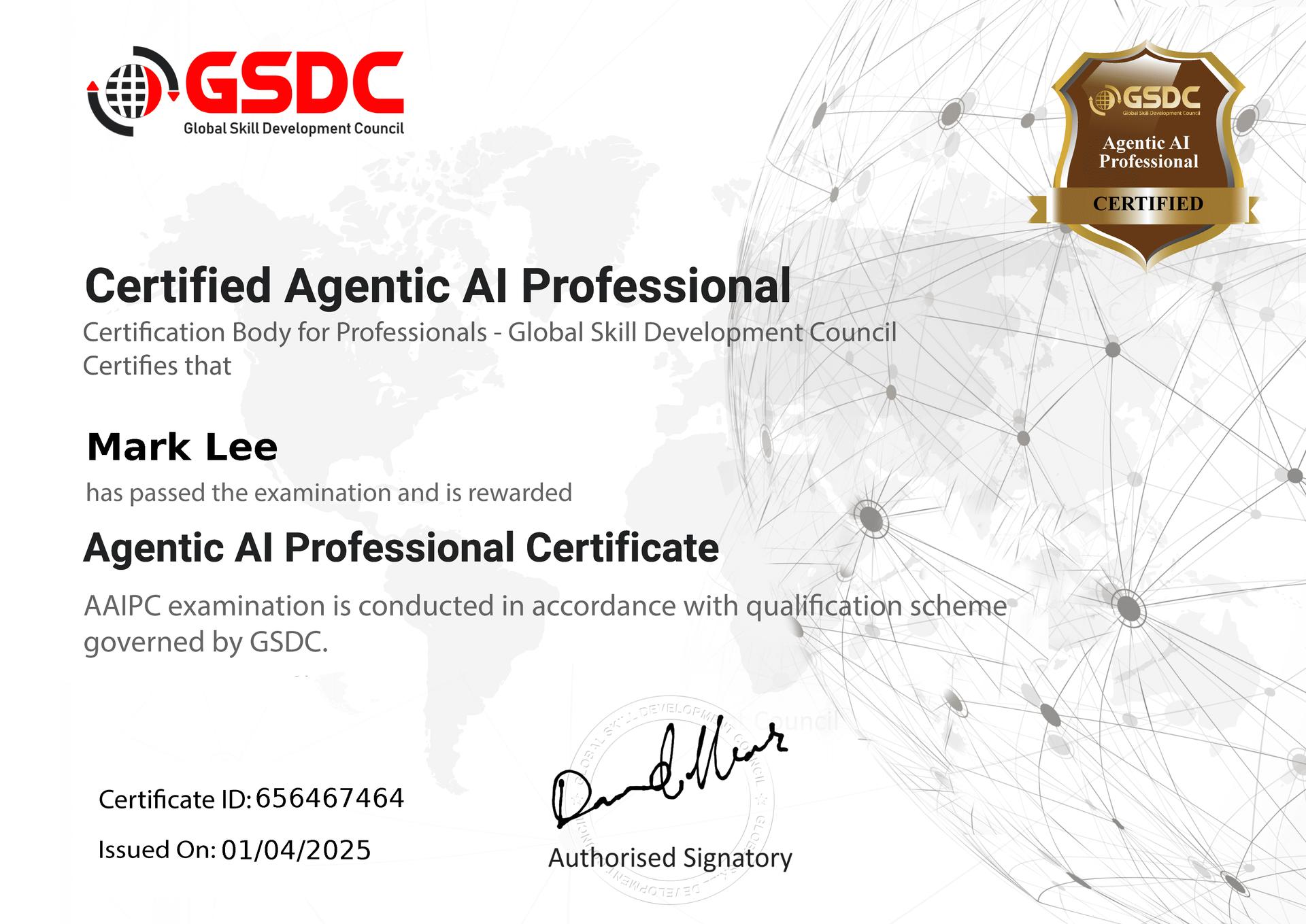
Exam Format - Objective Type, Multiple Choice
Exam Duration - 90 minutes
No. of Questions - 40 (multiple-choice questions)
Passing Criteria - 65%
Certificate - Within 5 business days
Result - Within 4 - 5 business days
Open Book: No
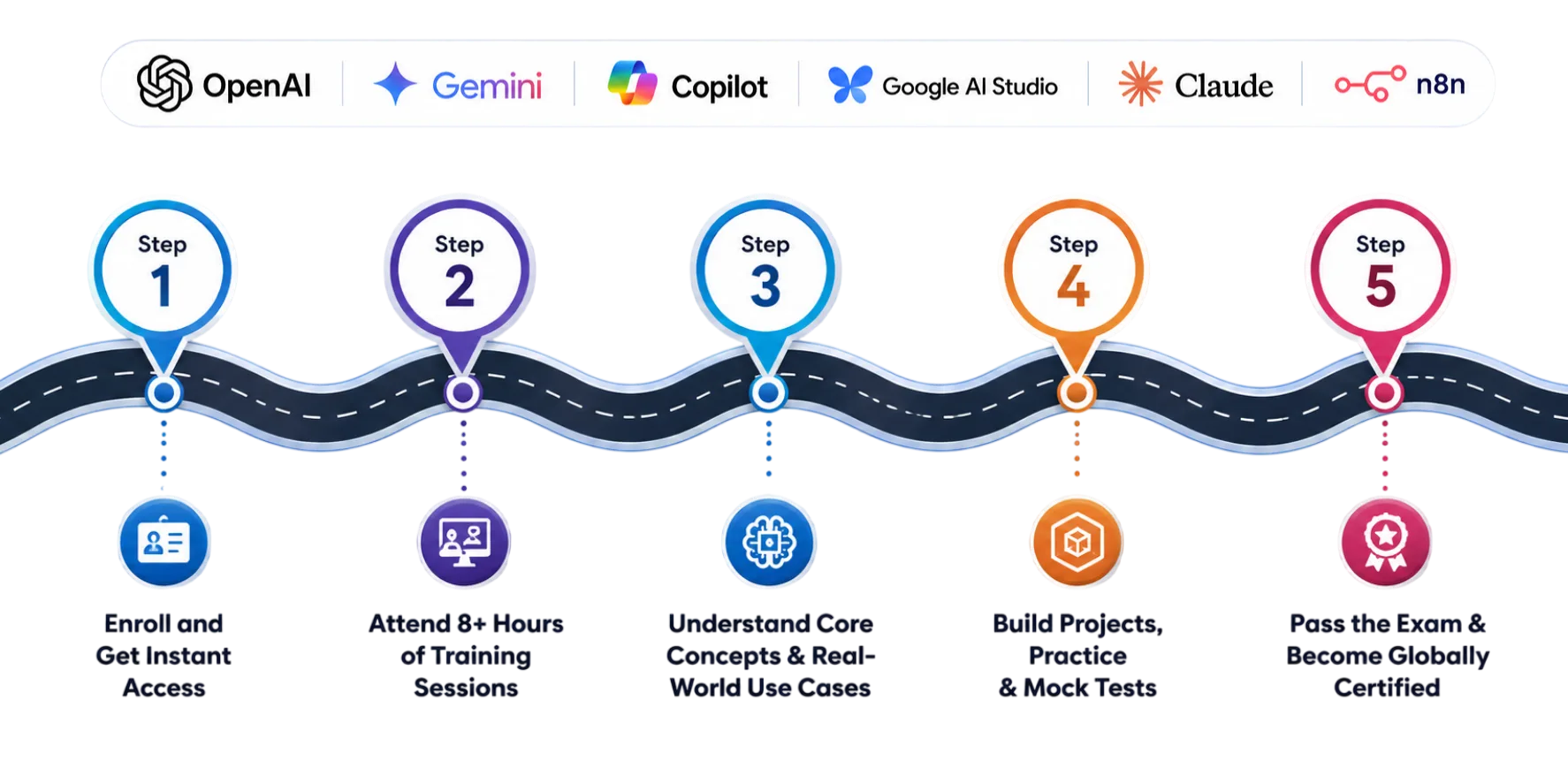
Agentic AI Certification Roadmap